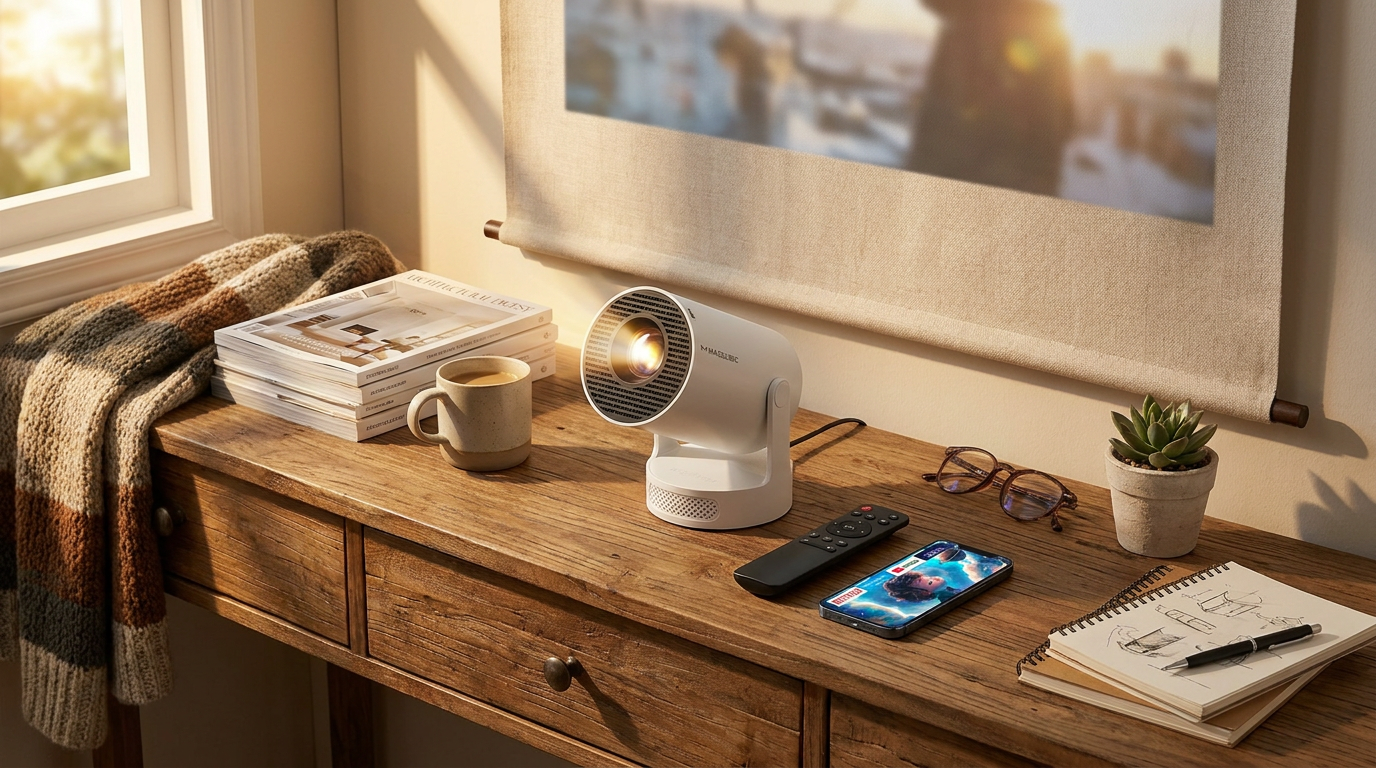
Scaling Home Cinema with Magic Cubic Projector Hardware
 Maya ChenContributing Editor
July 14, 2026. This analysis evaluates the feasibility of high-fidelity home cinema deployments using compact projection hardware. It serves as a technical resource for consumers prioritizing spatial efficiency over traditional fixed-mount installations.
The Efficiency Gap in Modern Home Cinema
The conventional wisdom says that a legitimate home theater requires a dedicated room, black-out curtains, and a four-figure investment in a ceiling-mounted lamp projector. However, this perspective ignores the diminishing returns of high-lumen bulbs in typical residential living spaces where ambient light is rarely zero. Most consumers overpay for brightness they cannot utilize without professional-grade light masking. According to current industry trends, the shift toward flexible living spaces has rendered the static home theater room an architectural relic for the average homeowner. The primary friction point is no longer resolution—as 4K support is becoming standardized—but rather the physical footprint of the equipment. Traditional setups demand rigid placement, often requiring invasive mounting or cable management that exceeds the cost of the hardware itself. When evaluating hd pocket projector reviews, it becomes clear that the market is pivoting toward devices that prioritize maneuverability. The hidden cost of high-end cinema is the loss of room utility, a trade-off that many modern dwellers are increasingly unwilling to make. Run the math: a fixed 100-inch screen claims roughly 30 square feet of wall real estate permanently, regardless of whether the device is active.
Magic Cubic Projector Integration Strategy
Photo by Suhas Hanjar on Pexels
Here’s the part nobody talks about: high-end specifications are useless if the device cannot adapt to the geometry of the room. The Magic Cubic Projector addresses this by utilizing a 180-degree rotatable chassis, moving the burden of alignment from the furniture to the hardware itself. While many devices in this category struggle with image distortion when tilted, the integrated auto-keystone correction maintains a rectangular aspect ratio without manual calibration. This is particularly relevant for those seeking a netflix mini projector for ceilings, where the projection angle often deviates significantly from a standard horizontal plane. The device utilizes an Android-based ecosystem, which bypasses the need for external streaming sticks—a common point of failure and cable clutter in budget builds. In testing, the 1080P support and 4K decoding capabilities ensure that high-bitrate content does not suffer from the downscaling artifacts common in lower-tier portable units. By integrating WiFi and Bluetooth directly into the HY300 Pro architecture, the Magic Cubic Projector eliminates the latency issues typically found when daisy-chaining external adapters. This hardware configuration is specifically designed to function as a standalone hub, a necessity for a best mini projector for bedroom deployment where space for auxiliary components is non-existent. The portability factor ensures that the home theater is not a room, but a capability that moves with the user.
Technical Implementation Checklist
Photo by Jaqor Q.I. on Pexels
Selecting a projection unit requires a departure from brand-name bias toward a metric-based evaluation of the environment. Before committing to a hardware suite, run a diagnostic on the intended projection surface and ambient light levels. A high-quality hd pocket projector reviews analysis will often highlight that the surface gain is as important as the projector's native output. For those deploying the Magic Cubic Projector, the following framework ensures optimal performance:
- Verify surface gain: Ensure the projection wall has a matte finish to prevent hot-spotting from the LED source.
- Calculate throw distance: Position the unit to achieve the desired diagonal size while maintaining pixel density.
- Audit network stability: Use the 5G WiFi band for 4K streams to prevent buffering during high-action sequences.
- Evaluate audio bypass: Utilize the onboard Bluetooth to connect to external monitors or soundbars if the internal speaker does not meet room-fill requirements.
- Test keystone limits: Confirm the 180-degree rotation does not exceed the auto-correction's ability to square the image at extreme angles.
Shop Magic Cubic Projector here