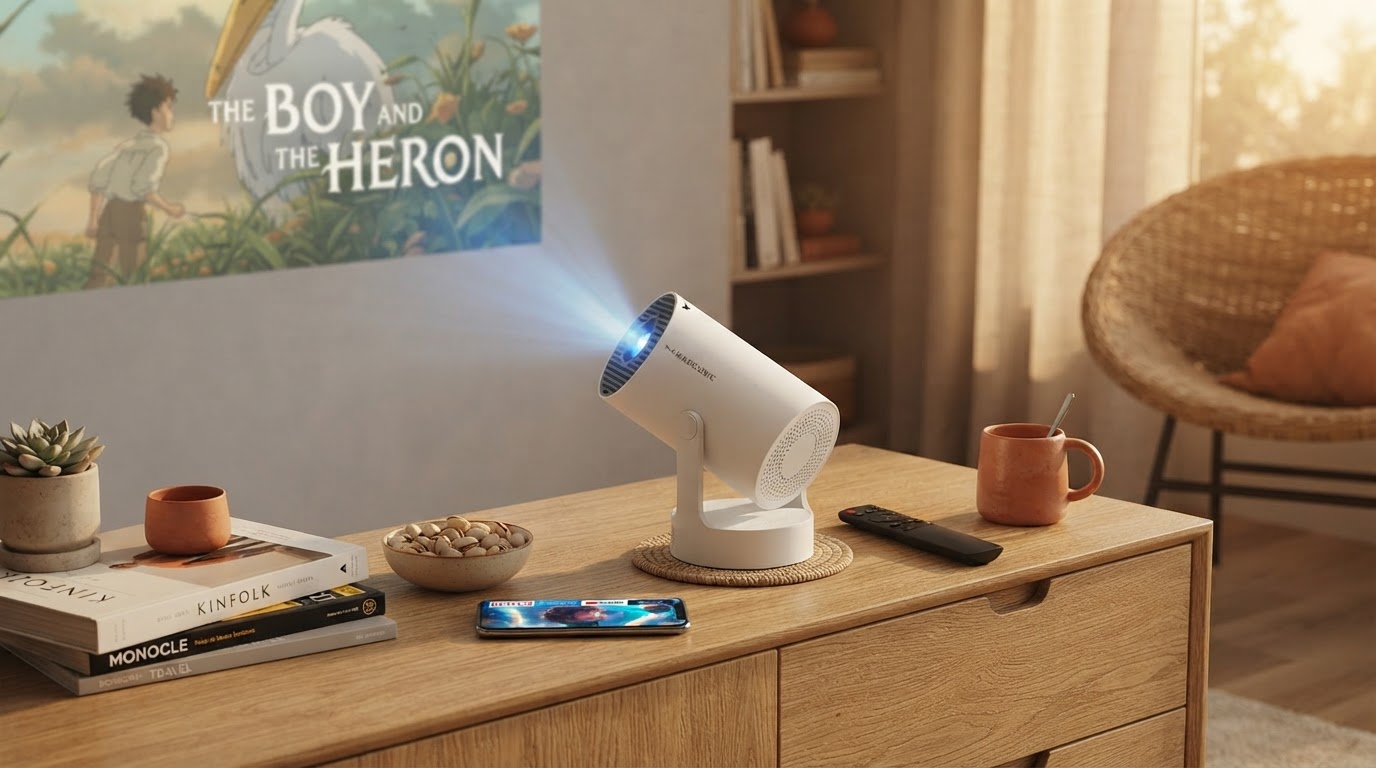
Magic Cubic Projector: Redefining Lifestyle Hardware
 Maya ChenContributing Editor
November 9, 2026 — The shift toward flexible, rotatable hardware is challenging the dominance of fixed-mount installations, with the Magic Cubic Projector emerging as a central figure in this transition. While the industry has long prioritized static brightness over ergonomics, consumer demand is pivoting toward devices that prioritize ease of placement and software integration over raw lumen counts.
The conventional wisdom says that a projector must be a heavy, ceiling-mounted box to provide a legitimate cinematic experience. However, recent analysis from RTINGS.com indicates that the market is bifurcating, with a distinct category of cheap projectors now offering enough utility for casual viewing without the traditional installation hurdles. This shift is driven by the realization that most consumers value the ability to project on a ceiling or a bedroom wall more than they value the marginal gains of a high-end lamp. As users look for a budget home theater projector under $100, the trade-offs between portability and peak performance are becoming the primary point of friction in the buying process.
The Three Utility Benchmarks
When evaluating the Magic Cubic Projector against the broader landscape of lifestyle hardware, three specific metrics determine long-term viability: rotation mechanics, keystone automation, and chip-level integration. Run the math: a device that requires manual four-corner correction every time it is moved ceases to be portable in any practical sense. The Magic Cubic Projector addresses this through a 180-degree rotatable chassis and integrated auto-keystone technology, allowing it to transition from a vertical wall to a ceiling in seconds. While enthusiasts often search for a budget 4k home theater projector to satisfy pixel-density requirements, the lifestyle segment is won or lost on the efficiency of its native operating system. The HY300-series architecture utilized here supports 1080P resolution and 4K decoding, but its real utility lies in the WiFi and Bluetooth stack that eliminates the need for external dongles. Here's the part nobody talks about: many competitors in this price bracket fail because their wireless modules lack the throughput for high-bitrate streaming, leading to stuttering that no amount of brightness can fix. By focusing on a stable Android-based ecosystem, this hardware avoids the 'black box' syndrome where a projector becomes a brick once its single HDMI port fails. When considering an hy300 projector alternative, the integration of the stand into the body itself remains a significant ergonomic advantage that few traditional manufacturers have successfully replicated. The hardware footprint remains small enough for travel, yet the internal cooling system is tuned to prevent the thermal throttling common in ultra-miniature builds.
Expert tip: To maximize the lifespan of a portable unit, always ensure the auto-keystone sensor is clear of dust; even a minor obstruction can force the software into a continuous adjustment loop that adds unnecessary lag to the video processing chain.
I’ll change my mind when traditional manufacturers can offer a 180-degree swivel mount and built-in streaming apps without tripling the price point of entry-level units. For now, the move toward integrated lifestyle designs like the Magic Cubic Projector represents the only logical path for the casual viewer. Those needing more specialized specs should evaluate their needs for a budget home theater projector under $100 before committing to a specific ecosystem.
Sources
- The 5 Best Budget And Cheap Projectors of 2026 - RTINGS.com
- $100-$500 Budget Home Theater Projectors Tested (2025 ...
- Should you buy a CHEAP projector in 2024? - YouTube