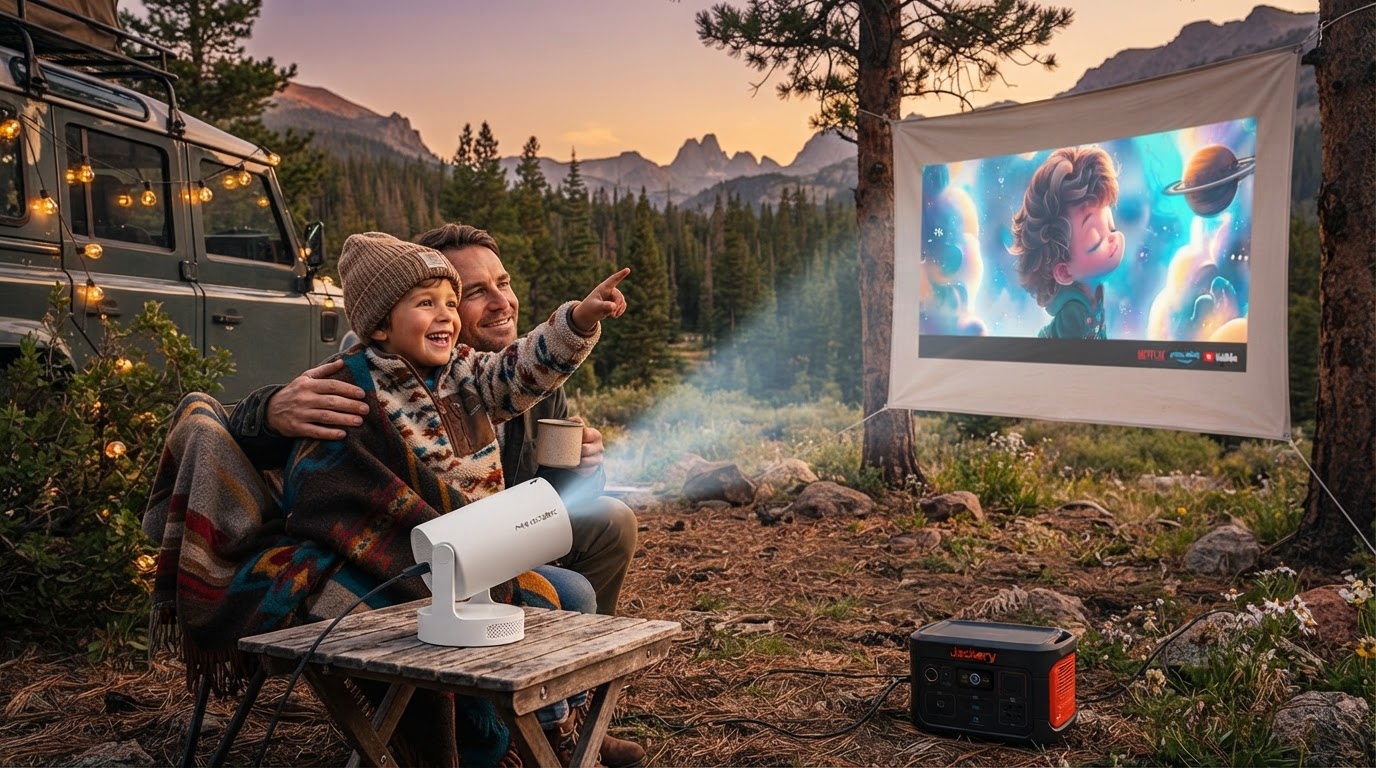
Magic Cubic Projector Setup for Off-Grid Camping
 Maya ChenContributing Editor
August 29, 2026—The trend toward digital nomadism has forced a reevaluation of portable hardware like the Magic Cubic Projector, which must now balance lumen output against the finite capacity of portable power stations.
The conventional wisdom says that outdoor projection requires high-wattage hardware, but off-grid enthusiasts are increasingly prioritizing efficiency over sheer brightness. While the BenQ GS50 is often cited by Outside Online as a camp-friendly option due to its IPX3 water resistance and 0.5m drop resistance, these rugged features often come at a significant price premium that may not align with the needs of a casual weekend traveler. For those managing strict weight limits, the technical challenge isn't just about surviving a rainstorm; it is about maintaining a stable 1080p stream from a smartphone while operating in a low-signal environment.
The 4-Point Field Deployment
Successful field deployment of the Magic Cubic Projector requires a strict adherence to power management and signal stability. Run the math: a standard portable battery with a 20,000mAh capacity will struggle to sustain a high-brightness projection for more than a single feature film if the internal cooling fans are working at maximum RPM. To optimize this, users must utilize the 180-degree rotatable stand to project onto light-colored, high-gain surfaces rather than dark tent walls, which allows for lower brightness settings and extended battery life. Connectivity remains the primary failure point in remote areas. While many rely on integrated Android systems, the most reliable method for off-grid use is a direct wired connection or a local Wi-Fi hotspot generated by the phone. This bypasses the need for external routers and reduces the latency issues commonly found in budget hardware. The Magic Cubic Projector’s auto-keystone correction becomes essential here, as perfectly level surfaces are rare in a campsite. However, the part nobody talks about is heat dissipation; placing a projector on a sleeping bag or grass will lead to thermal throttling. A hard, flat surface is non-negotiable for maintaining the internal hardware's longevity during a multi-hour outdoor session. Unlike bulky alternatives, the compact form factor of the HY300 Pro series allows it to fit into standard camera inserts, providing necessary protection without the bulk of dedicated ruggedized cases.
Expert tip: When projecting from a smartphone in areas with zero cellular service, download your media for offline playback and set your device to airplane mode to prevent the projector's wireless handshake from constantly draining the phone's battery.
For those interested in different environments, you might consider how this compares to the best budget projector for gaming or an affordable 4k outdoor movie projector for backyard use. While this unit excels in portability, users looking for permanent installations often prioritize different specs. I’ll change my mind when manufacturers integrate high-capacity solid-state batteries directly into the chassis without doubling the weight, but until then, external power management remains the user's responsibility.
Sources

Photo by Junior Teixeira on Pexels
- What are good cellphone projectors for off-grid camping?
- The 6 Best Portable Projectors of 2026
- Looking for the best portable projector for camping? Read ...