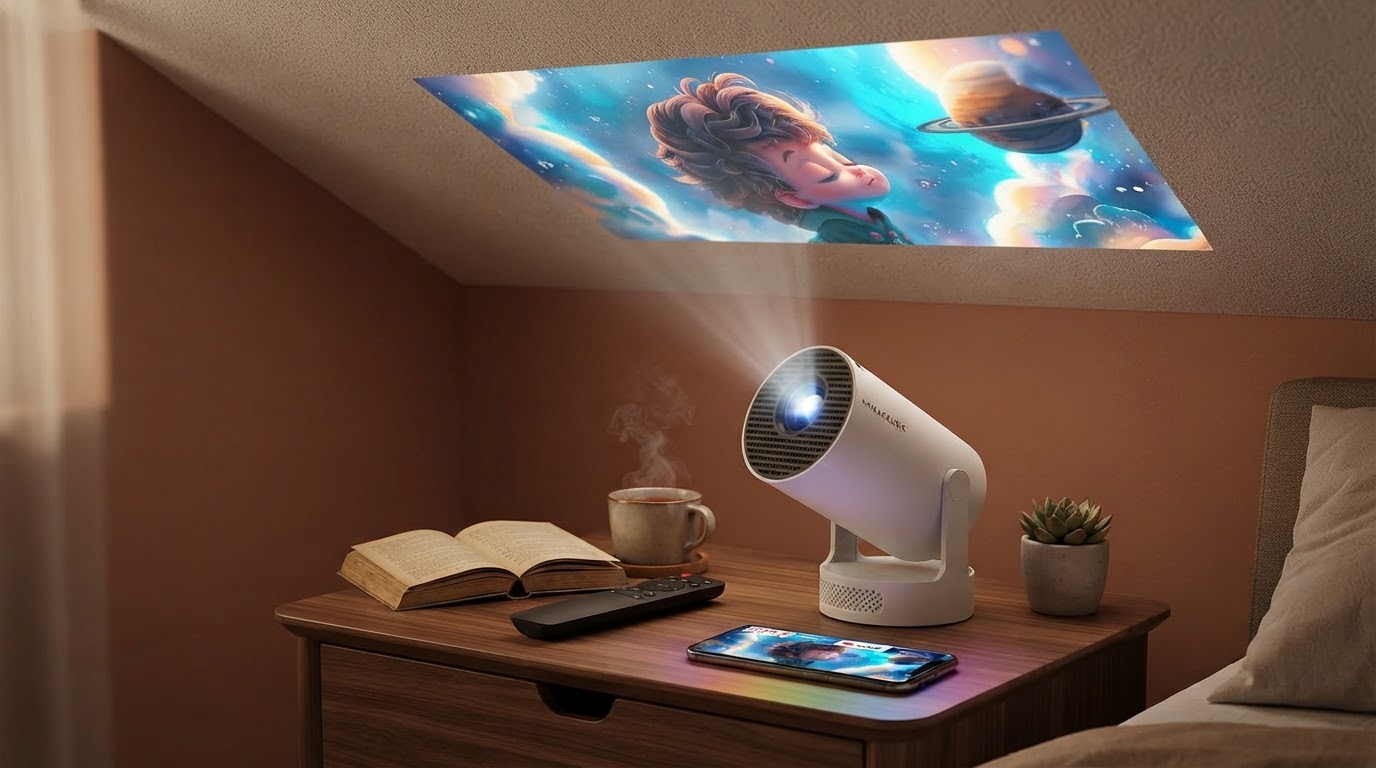
Optimizing Ceiling Projection with Magic Cubic Projector
 Maya ChenContributing Editor
November 1, 2026. This analysis evaluates the mechanical and optical requirements for vertical image placement in residential environments. It is intended for consumers who prioritize ergonomic viewing over traditional horizontal home theater configurations.
The conventional wisdom says that any portable projector can simply be tilted upward to achieve a ceiling-mounted image. However, according to ProjectorCentral's expert community on Facebook, the placement of the projector matters significantly, and lifestyle projectors often struggle with heat dissipation or image distortion when operated at extreme vertical angles. Most standard units are designed with horizontal venting systems that, when pointed straight up, cause heat to pool near the lamp or LED source, shortening the lifespan of the internal components. Furthermore, the reliance on digital keystone correction to fix the resulting trapezoidal distortion often results in a 20-30% loss in effective resolution. While high-end units like the XGIMI HORIZON Pro offer 1500 ISO Lumens and 4K technology, as noted in XGIMI's buying guides, these larger chassis are rarely optimized for the specific physical rotation required for true vertical projection without specialized mounting hardware.
Here's the part nobody talks about: the Magic Cubic Projector bypasses these thermal and mechanical limitations through its 180-degree rotatable chassis. Unlike fixed-lens competitors that require precarious tripod setups to reach the ceiling, this unit utilizes a center-axis hinge that maintains airflow regardless of the projection angle. The hardware supports 4K input and native 1080P output, ensuring that the pixel density remains high even when the image is scaled for a portable smart projector for bedroom environment. The inclusion of Auto Keystone technology is not merely a convenience; it is a necessity for ceiling setups where the projector might be placed on an uneven bedside surface. By automating the alignment, the Magic Cubic Projector maintains a 16:9 aspect ratio without the manual calibration hurdles that plague standard portable units. This makes it a superior choice when compared to the generic best mini projector for bedroom ceiling options that lack a dedicated rotating stand.
When selecting hardware for vertical viewing, run the math: a projector without a built-in rotating base will require an additional $30 to $50 in mounting accessories just to achieve stability. A dedicated ceiling projection for movies at home setup requires more than just a lens pointed upward; it requires a stable base that won't tip over under the weight of its own cables. The Magic Cubic Projector integrates this stability into the frame. Before finalizing a purchase, consumers should evaluate their space using the following framework:
- Verify the rotation range: Ensure the hinge allows for a full 180-degree arc to accommodate both wall and ceiling surfaces.
- Check for automated alignment: Manual keystone is insufficient for the micro-adjustments needed when projecting onto high-sloped or vaulted surfaces.
- Assess thermal venting: Confirm that the cooling fans are not obstructed when the lens is pointed vertically.
- Validate connectivity: Ensure the unit supports dual-band WiFi to prevent buffering during high-bitrate 4K streaming.
- Measure throw distance: Calculate if the distance from the floor or nightstand to the ceiling provides the desired screen size.
Shop Magic Cubic Projector here: https://magiccubicprojector.com
Sources
- BenQ Ceiling Projector - Project movie onto Ceiling | BenQ US
- What projectors are best for vaulted ceiling video projection? - Facebook
- Ceiling Mounted Projector Buyer Guide: What is it and How to Choose