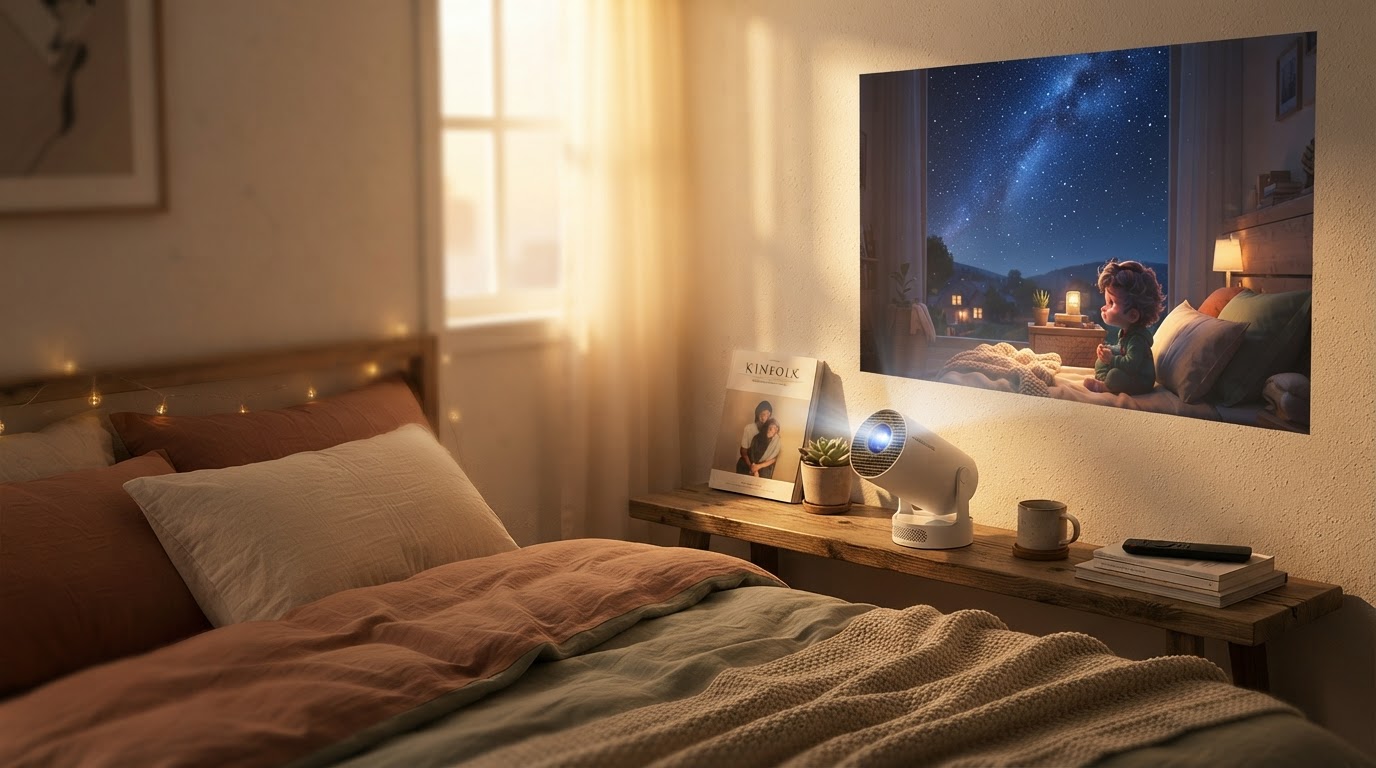
Selecting a Magic Cubic Projector for Bedroom Use
 Maya ChenContributing Editor
September 12, 2026 — The recent surge in compact home theater demand has positioned the Magic Cubic Projector as a primary contender for small-space entertainment. While the industry often prioritizes raw lumen count for large living rooms, the specific constraints of a bedroom require a shift toward maneuverability and software integration.
The conventional wisdom says that higher brightness is the only metric that matters for a quality image, but this ignores the reality of light control in a sleeping area. TechRadar reports that modern testers now prioritize "room to room" smart functionality and built-in streaming over pure hardware specs for portable units. When evaluating hardware for a bedroom, the ability to bypass external streaming sticks becomes the baseline for usability rather than a luxury feature.
The Bedroom Logic Framework
Run the math: a standard bedroom rarely offers the 10-to-15-foot throw distance required by traditional long-throw units, making the 180-degree rotatable chassis of the Magic Cubic Projector a technical necessity rather than a gimmick. This specific hardware configuration, often identified as the HY300 Pro model, supports 4K input with a native 1080P output, ensuring that high-resolution content isn't downscaled to the point of illegibility at close range. The integration of 5G WiFi and Bluetooth allows for a wireless audio handoff to bedside speakers, solving the common cable-management crisis inherent in temporary setups. Unlike static units, the 180-degree rotation facilitates ceiling projection for movies at home without requiring a specialized tripod or precarious stacking of books. This flexibility is critical when optimizing Magic Cubic Projector setup for ceiling movies because it allows for keystone correction to engage automatically, squaring the image against the often-uneven architecture of a bedroom ceiling. While competitors like the Miroir M700S offer 1080p smart portable capabilities at a $299.99 price point, they often lack the integrated rotatable stand that defines the Magic Cubic form factor. For users specifically seeking a portable smart projector for bedroom use, the mechanical ability to pivot the lens toward the ceiling provides a functional advantage that software-only solutions cannot replicate.
Expert tip: Use the auto-keystone feature only for minor adjustments; for the sharpest bedroom image, physically align the Magic Cubic Projector lens as parallel to the wall or ceiling as possible to maximize the effective pixel density of the 1080P output.
Choosing the right hardware involves acknowledging that a bedroom is not a dedicated cinema. Integrating a portable smart projector for bedroom environments requires balancing noise floor, heat dissipation, and physical footprint. I’ll change my mind when a fixed-lens unit can provide the same ergonomic comfort as a rotatable design without requiring a ceiling mount installation.
Sources
- Mini HD Travel Projectors | Small Portable Projectors - Miroir USA
- The 4 Best Portable Projectors of 2026 - RTINGS.com
- Best portable projector 2026: Tested for streaming & presenting