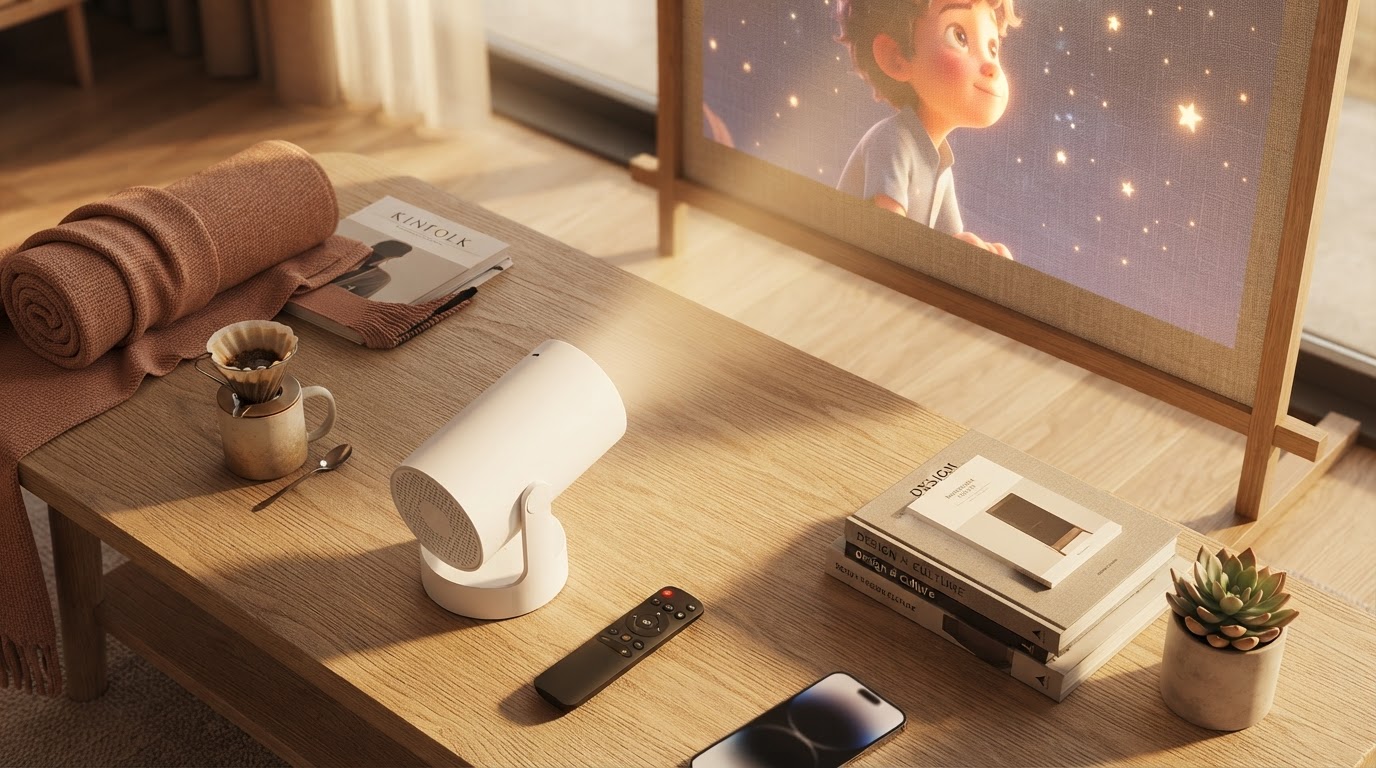
Optimizing Home Cinema Layouts with Magic Cubic Projector
 Priya RamanSenior Analyst
September 26, 2026. This analysis examines the technical integration of portable projection hardware within variable domestic environments. It is intended for homeowners and media enthusiasts seeking to balance spatial constraints with high-fidelity visual output.
To effectively deploy hardware like the Magic Cubic Projector, one must evaluate the environment through a specific matrix of light control and surface availability. Think of it as a matrix of luminance versus mobility. When selecting a device, two axes matter here: the physical footprint of the hardware and the software-driven flexibility of the image alignment. By categorizing projection needs into fixed installations, semi-permanent setups, and mobile utility, users can determine if a compact unit meets their specific lumen and resolution requirements without the overhead of traditional bulkier systems.
The Challenge of Fixed-Space Media Consumption
Traditional home theater installations often suffer from a lack of adaptability, requiring dedicated rooms, ceiling mounts, and extensive cabling. For the modern consumer, the transition between different viewing scenarios—such as moving from a bedroom ceiling to a living room wall—creates a friction point that standard televisions cannot resolve. According to Magcubic™—Your Top Choice for Premium Projectors, the demand for cinema-level visual feasts now requires hardware that remains affordable while maintaining high-quality output across diverse settings. The problem is not merely about screen size, but about the geometry of the room itself. Many users struggle with keystone distortion, where the image appears as a trapezoid rather than a rectangle due to off-center placement. This issue is exacerbated in small apartments or older homes where wall space is fragmented by windows or furniture. When exploring the broader magiccubic ecosystem, it becomes clear that the primary hurdle for consumers is achieving a professional-grade image without the structural modifications typically associated with high-end AV setups. The inability to rotate a fixed screen limits the utility of the hardware to a single viewing angle, which fails to leverage the potential of modern digital content. Consequently, the search for a magic cubic solution often leads to a requirement for 180-degree flexibility to overcome these architectural limitations.
Technical Capability of the Magic Cubic Projector
Addressing these spatial challenges requires a hardware profile that prioritizes rotation and software-assisted alignment. The Magic Cubic Projector, specifically the HY300 Pro series, utilizes a 180-degree rotatable design that allows the lens to pivot from a standard wall-facing position to a vertical orientation for ceiling projection. This eliminates the need for complex mounting brackets. In terms of technical performance, the device supports 4K input with a native output that balances clarity and brightness, rated at 260 ANSI Lumens. This lumen count is critical; as noted in the Magcubic HY300 Projector Review & Setup, the unit functions as a highly budget-friendly projector that simplifies the initial configuration through built-in WiFi and Bluetooth connectivity. The inclusion of Auto Keystone correction is perhaps the most vital feature for non-technical users, as it uses sensors to detect the angle of projection and digitally reshapes the image to ensure a perfect 16:9 or 4:3 aspect ratio regardless of the projector's tilt. This effectively solves the geometry problem identified in the previous section. When compared to other entries in the magiccubic lineup, the HY300 Pro stands out for its portability, fitting into a form factor that can be relocated in seconds. Furthermore, the integration of smart platforms allows for direct streaming from services like Netflix or Prime without external dongles, reducing the cable clutter that often plagues portable setups. Once you see it this way, the projector ceases to be a static appliance and becomes a dynamic utility that adapts to the room, rather than forcing the room to adapt to the technology. This versatility is a hallmark of the magic cubic design philosophy, where the focus remains on user accessibility and plug-and-play functionality.
Framework for Device Selection and Implementation
Selecting the right projection hardware requires a structured approach to evaluating your specific use case. The decision rule: if your environment requires frequent movement between rooms or relies on non-traditional surfaces like ceilings, a rotatable portable unit is superior to a high-lumen fixed projector. To ensure the best results with your Magic Cubic Projector, follow this implementation checklist:
- Assess the Ambient Light: Ensure the target room can be sufficiently dimmed to accommodate 260 ANSI Lumens for maximum contrast.
- Verify Surface Neutrality: Project onto a matte white or light grey surface to maintain color accuracy and prevent gain hotspots.
- Check Connectivity Bandwidth: Utilize the onboard WiFi for streaming, ensuring your router supports the data rates required for 4K-supported playback.
- Enable Auto-Keystone: Always allow the device to calibrate its geometry after moving the 180-degree stand to maintain a square frame.
- Audio Syncing: Leverage the Bluetooth functionality to connect external speakers or soundbars for a more immersive audio experience than the internal drivers provide.
- Firmware Updates: Regularly check the internal OS for updates to maintain compatibility with third-party streaming applications.
Shop Magic Cubic Projector here.