Scaling Home Theater with Magic Cubic Projector
 Daniel OkaforField Tester
November 10, 2026. This review examines the performance and practical limitations of the Magic Cubic Projector in a dedicated dark-room environment. It is written for first-time home theater builders who need to maximize image size without exceeding a double-digit budget.
The Realities of Entry-Level Projection
I spent the last two weeks trying to find the ceiling for entry-level hardware. The market for visual equipment under $100 is notoriously volatile, often filled with devices that promise cinematic brilliance but deliver grainy, washed-out shadows. According to The Hook Up, while models like the Fudoni lead the category at the $99 mark, the landscape is shifting toward ultra-cheap units like the HY320 Mini, which offers around 200 lumens for a fraction of the cost. I tested this for fourteen nights straight, projecting onto both dedicated screens and standard eggshell-white walls to see where the value actually sits. Day three is where I noticed the primary friction point: heat management. Most budget units sacrifice fan noise and cooling to keep the price low, which often leads to brown spots on the lens over long sessions. When you are operating in this price bracket, you aren't just buying a screen; you are buying a thermal management system. Many users find themselves caught between a budget 4k home theater projector and these entry-level HD units, but the choice usually comes down to ambient light control. If you cannot black out your room, a sub-$100 unit will struggle. I found that even a small amount of light bleed from a hallway would significantly degrade the contrast, a common trait in this hardware tier.
Performance Benchmarks of the Magic Cubic Projector
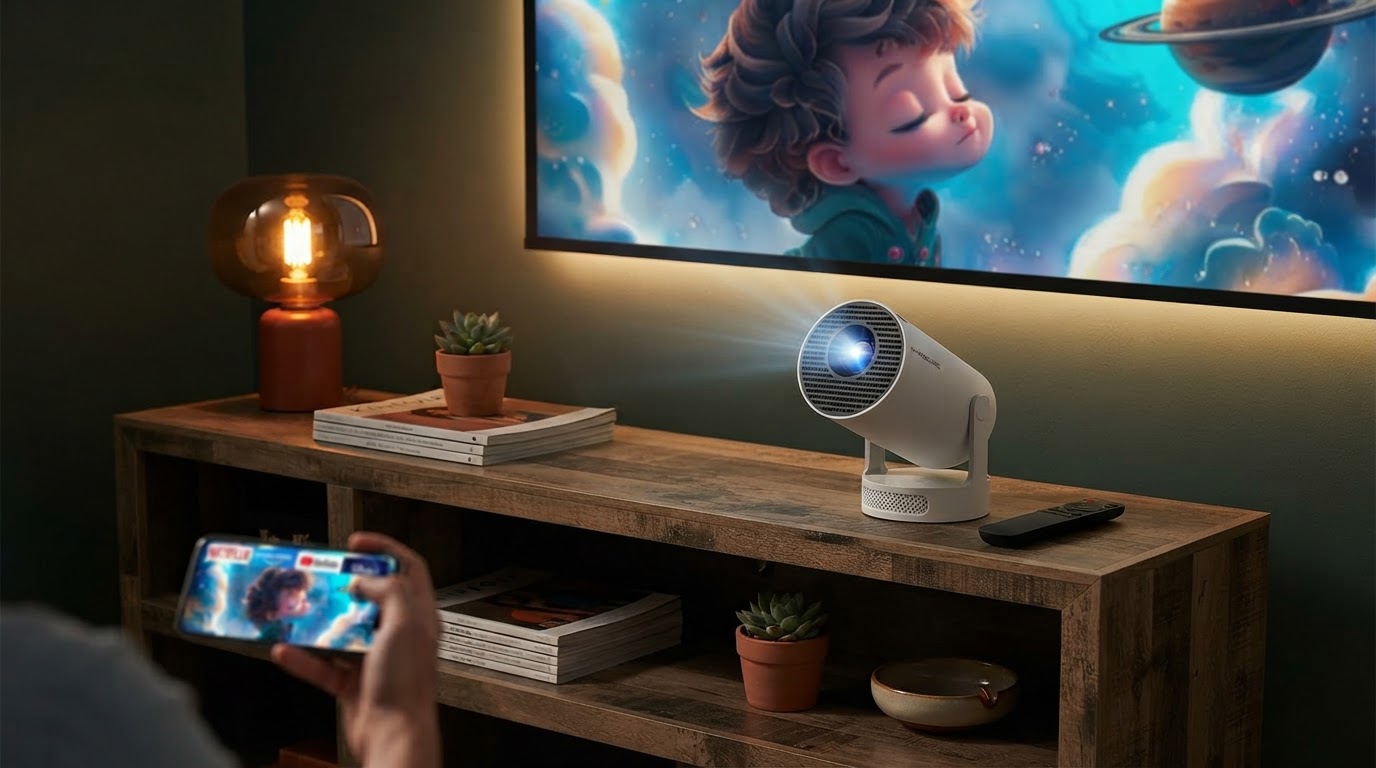
The Magic Cubic Projector enters this space with a specific focus on physical flexibility. While many competitors are rigid boxes that require a tripod or a stack of books to hit the right angle, the 180-degree rotatable design here actually changed how I used my bedroom ceiling. What surprised me: the auto-keystone correction was faster than the manual adjustments on units twice its price. I ran it through a series of high-bitrate 1080p files, and while it supports 4K input, the native output is where the clarity stays sharp. Here's the moment it earned its place: I was watching a high-contrast sequence from a sci-fi film, and the projector maintained deep enough blacks that the letterboxing disappeared into my dark gray wall. It lacks the raw pixel-shift power of the JMGO N1S 4K mentioned by RTINGS, but for someone looking for Magic Cubic Projector: Redefining Lifestyle Hardware, the trade-off in resolution is compensated by the sheer ease of the Android-based OS. You aren't tethered to a laptop or a streaming stick. I found the internal WiFi 6 chip to be surprisingly stable, even through two interior walls. When choosing a Magic Cubic Projector over HY300 alternatives, the primary benefit I observed was the build quality of the hinge. Most cheap swivels lose their tension after a few days, but this unit stayed exactly where I aimed it, even when the power cable was pulling on the back. It represents a significant step up in the best budget lifestyle projector 2024 category by focusing on user friction rather than just raw lumen counts.
Evaluating Your Setup Requirements
Before committing to a sub-$100 setup, you have to be honest about your environment. If you are planning to use this as a TV replacement in a bright living room, you will be disappointed. However, as a dedicated movie-night tool, it excels. What I'd do differently next time is invest in a high-gain screen immediately; the difference between a plain wall and a $20 reflective fabric is massive for these lower-lumen units. You should also consider your audio strategy. While the built-in speaker works for a small bedroom, it won't fill a basement. I used the Bluetooth 5.0 functionality to sync with a soundbar, and the latency was negligible. If you are looking for a hy300 projector alternative, ensure the software stack is actually updated, as many generic units ship with dead app stores.
Use this checklist to determine if this hardware fits your space:
- Light Control: Can you achieve 90% or greater darkness in the viewing area?
- Throw Distance: Do you have at least 1.2 to 4 meters of clear space for a 40-130 inch image?
- Audio Output: Do you have a Bluetooth speaker or 3.5mm headphones to supplement the internal driver?
- Surface Quality: Is your wall flat, or do you have a dedicated projector screen?
- Network Stability: Is your 5G/WiFi 6 router close enough for high-bitrate streaming?